
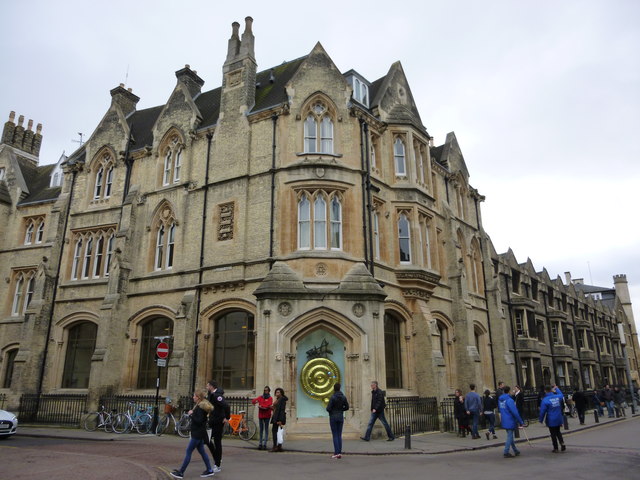
Installed outside the Taylor Library at Corpus Christi College, this large, golden clock (the Corpus Clock) was unveiled in 2008 by Stephen Hawking. It was designed by Dr John C. Taylor, a Cambridge alumnus and inventor, who created it as both a tribute to the time and a reminder of its relentless passage.
The Corpus Clock draws a lot of attention, both for its unusual design and for the questions it raises about time, mortality, and invention. It’s a must-see for those who appreciate unique, thought-provoking creations, adding a modern twist to the historic streets of Cambridge.
About Cambridge's Corpus Clock
The most striking feature of the Corpus Clock is its “chronophage,” which translates from Greek as “time-eater.” Perched at the top of the clock, this metallic, grasshopper-like creature has a haunting, mechanical look.
Every time the clock ticks, the chronophage seems to “devour” a second, reminding viewers of the inevitability of time slipping away. The creature’s movements are deliberately unnerving, with its mouth opening and closing as it “eats” time while its spiky legs crawl around the circular clock face.
Unlike traditional clocks, the Corpus Clock has no hands. Instead, it uses a series of LED lights that illuminate the face in three concentric rings, showing hours, minutes, and seconds as they pass. The clock is designed to appear slightly erratic, speeding up or slowing down at moments before resetting itself. This symbolizes the unpredictable nature of time, making it both a work of art and a philosophical statement.
How to Get There
The Corpus Clock is located at the junction of Bene’t Street and Trumpington Street, overlooking King’s Parade in the heart of Cambridge. It’s mounted at street level on the exterior of the Taylor Library at Corpus Christi College.
- Walking: The Corpus Clock is centrally located and easily accessible on foot from most parts of the city center.
- Public Transport: Local buses and taxis are available, but walking is often the most convenient way to explore Cambridge’s compact center.


